Farewell, Forever
——Three brothers. All killed in the war. The youngest wrote “freedom” on paper, and was gone.
In a lively country clinic in Azumino, Nagano, there were five siblings. Three of them were boys. All three boys died in the war.
The youngest son, Uehara Ryoji, was twenty-two. A student at Keio University, good on the harmonica, a devoted reader of an Italian philosopher. Chosen as a kamikaze pilot, he spent the night before his sortie writing his thoughts, one sheet after another. He titled it Shokan (“Reflections”). In it he called himself a “liberal,” wrote that authoritarian states must always fall in the end, and the next morning flew off toward the sea at Okinawa.
This page retraces the fuller picture of this man — more than the films (episodes 1 to 4) could follow — using only verifiable facts and his own words. His last writings are among the most widely read of any Japanese student-soldier's. And precisely because of that, we also look at how later generations “edited” him (⑨ In more detail).
① Three brothers, all killed in the war 🟢 Confirmed
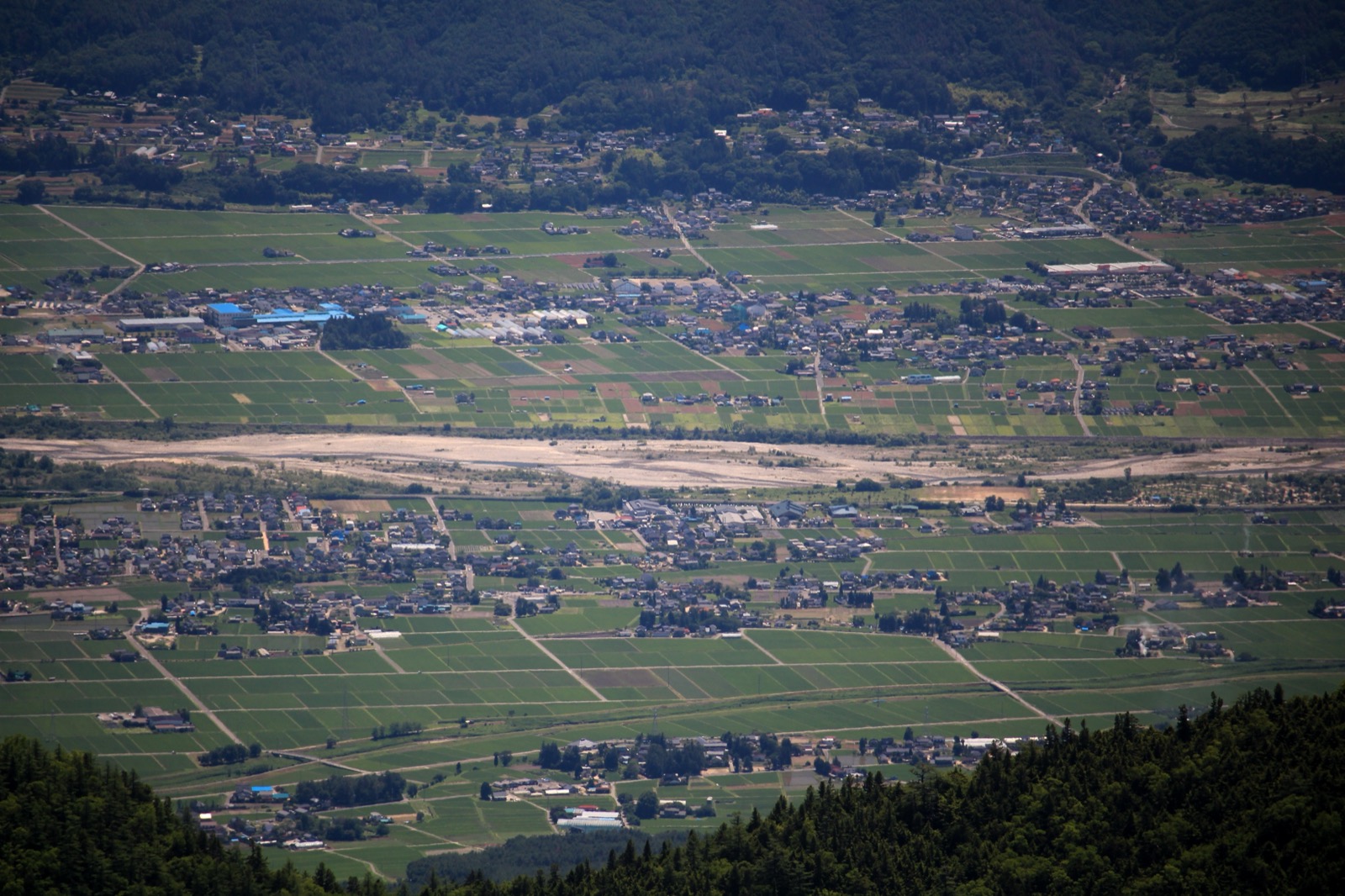
Uehara Ryoji was born on 27 September 1922 in Ikeda, Kita-Azumi District, Nagano, and grew up in Azumino. His father, Toratarō, was a physician (later sent to the front as an army surgeon); his mother was Yoshie. He was the third son of five children.
When his father went to war in China, the five siblings each held up a single character on a board and sent him a photograph: “Go, Father!!” From the left: eldest son Yoshiharu, second son Tatsuo, third son Ryoji, eldest daughter Kiyoko, second daughter Toshie. A picture of pure innocence. Of these five, all three of the boys would die in the war.
- Tatsuo, second son (26) — October 1943, off Australia (submarine attack)
- Ryoji, third son (22) — May 1945, Okinawa (kamikaze)
- Yoshiharu, eldest son (31) — September 1945, Burma (death from illness)
Source: Ajima Takayoshi, Uehara Ryoji and the Kamikaze (rev. ed., 2010), photo section; accounts by Nakajima Hiroaki. The subjects' rights term has expired; quotations are handled with attribution.
② “Kyoko, farewell” — the code hidden in a book 🟢 Confirmed
Ryoji had loved someone since childhood: Ishikawa Kyoko, a girl as close as family. But in 1943 Kyoko became engaged to another man, and the next year she died of tuberculosis.
On 6 June 1944, learning of Kyoko's death from his sister's letter, Ryoji wrote a single line in his diary that day.
Today, I died.
Then, in the endpapers and text of a book he loved, he began marking small circles in black ink. Read the circled characters in order, and a code no one would notice rises to the surface — an anagram.
Kyoko, farewell. I loved you. But by then you were already promised to another. I suffered. And when I thought of your happiness, I gave up on whispering words of love. Yet I love you still, always.
Source: Uehara's diary (“Today, I died”); the circle-mark anagram in his copy of Croce — from the biographical record of Uehara Ryoji (primary sources, 2026) and the Ajima photo book. The character used for Kyoko's name follows the form used in the sources.
③ Keio, and Croce — meeting the word “freedom” 🟢 Confirmed
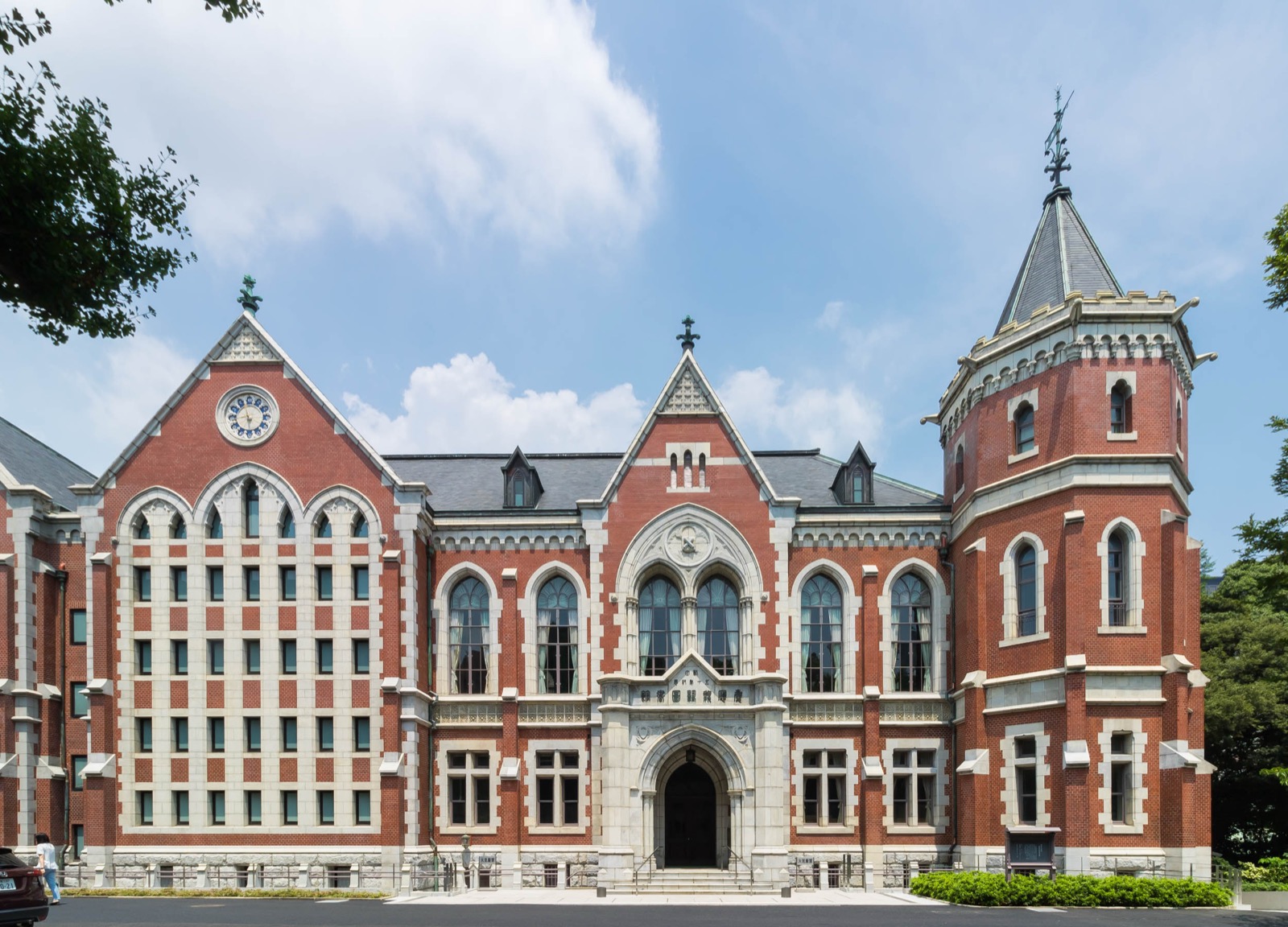
After Matsumoto Middle School (now Matsumoto Fukashi High School, known for a spirit of self-governance and independence) and a year as a rōnin, Ryoji entered the preparatory course of Keio University in 1941. What he threw himself into there was the Italian historian-philosopher Benedetto Croce.
Croce opposed Mussolini's fascism and preached the preciousness of freedom. Ryoji's favorite book was Croce, a study of the philosopher by the historian Hani Gorō. “Freedom is human nature itself; even when it seems suppressed, it fights on beneath the surface and in the end must win” — this idea of Croce's became his backbone.
In December 1943 he entered the army. Amid senseless violence and pointless drills, his thinking about freedom only grew stronger. In the “Self-Reflection Notebook” where trainees recorded their impressions, he wrote: “It is regrettable how few people of character there are in this training unit.” To this open criticism of his superiors came a reply in red ink: “Do you mean to criticize your superior officers?!” “Rid yourself of your student mentality!”
Source: biographical record of Uehara Ryoji (entry to Keio prep course; reception of Croce; Hani Gorō's Croce; the Self-Reflection Notebook criticism and red-ink rebuke) — confirmed against primary texts, 2026.
What gakuto shutsujin (学徒出陣) was — from the university desk, straight to the war →
④ Toward the sortie — three farewells to his mother on Chibusa Bridge 🟢 Confirmed
In April 1945, Ryoji was chosen as a kamikaze pilot and made his last visit home. He could not say the words of farewell to his mother.
At a close friend's house, he let slip: “Going to your death, not one man volunteers gladly. They engineer a situation where you have no choice but to raise your hand.” To his sister he said: “Japan will lose. I die for the people I love.”
And on his way back to his unit — leaving the house, stopping far off on Chibusa Bridge — he cried out, three times, louder than anyone had ever heard him:
“Farewell.” “Farewell.” “Farewell.”
His mother thought: “Ryoji means to die.”
Source: accounts of his friend and sister, and the parting at Chibusa Bridge — from Nakajima Hiroaki (verified for the episode scripts). ⚠️ His remark to his friend, to the effect that the “volunteering” was coerced, is not consistent across sources (⑨).
⑤ Chiran, and the “Reflections” — a liberal's last writing 🟢 Confirmed
On 3 May 1945, Ryoji arrived at the army airfield at Chiran, Kagoshima, as part of the 56th Shinbu Unit. To Torihama Tome, proprietress of the nearby Tomiya diner, he murmured: “Ma'am, Japan is going to lose.”
On the night of 10 May, with the sortie set for the next morning, army press correspondent Takagi Toshirō held out sheets of paper and asked him to “write your true feelings.” Ryoji asked, “May I write anything?” and began, in silence. He titled it “Reflections.” Seven sheets of Nippon Eigasha press manuscript paper. There he named himself a “liberal” and wrote:
I believe the victory of freedom is beyond doubt. (…) A state of authoritarianism and totalitarianism may flourish for a time, but that in the end it must fall is an obvious fact.
A pilot of the sky's special attack corps is no more than a machine. (…) nothing but a single particle of iron in a magnet, drawn to the enemy's aircraft carrier.
When the woman I loved died, I too had already died with her, in spirit. (…) Death is only a stage on the road to heaven, so it is nothing at all.
And the closing lines, so very well known:
Tomorrow, one liberal departs this world. His retreating figure is lonely, but his heart is full of contentment.
The reason that declares authoritarianism “must fall,” and the obedience that receives the kamikaze order as an “honor,” live together within the same seven sheets. We do not explain this doubleness. We leave it in his own words.
Source: the “Reflections” (Uehara Ryoji's last writing; the author's own document, rights term expired) — episode scripts and biographical record. There are other views on how the “Reflections” came to be (⑨).
Read about the 56th Shinbu Unit — the “volunteering” paper that made him a kamikaze pilot →
⑥ The sortie, and a silent homecoming 🟢 Confirmed
Before dawn on 11 May 1945, Ryoji rose, smoked the last cigarette of the “Asahi” pack his mother had given him, sang in a circle with the others, and took off, lingering over Mt. Kaimon. His escort pilot (whose role was to guard the attack plane to its target and turn back), Yoshihara Toshinori, later testified: “Uehara's plane waggled its wings, opened the canopy and waved a hand, waved a scarf, gave a salute, and charged straight for the enemy ships off Okinawa.”
Around nine in the morning, he died over Kadena Bay, Okinawa. He was twenty-two.
Three months later, the empty box of that “Asahi” pack reached his mother. On the back, a poem was written:
The sweet last smoke on the morning of my sortie — a gift from my dear mother.
On 26 April 1946, across that same Chibusa Bridge where he had cried “Farewell” three times, Ryoji crossed in silence, held in a small urn. The posthumous name given at his village funeral was Tokkō-in Junkū Ryoji Daikoji (a name marking one martyred to the sky). That September his eldest brother Yoshiharu also died in Burma; not one of the three brothers came home.
Source: the sortie, death, the poem on the empty box, the urn at Chibusa Bridge, and the posthumous name — episode scripts (Nakajima Hiroaki and others). Escort pilot: Yoshihara Toshinori.
This page reached one man, Uehara Ryoji, by way of a single sheet of paper — the “Reflections.” There is also a road that runs the other way. The published listing of the army's special attack units sets out the members unit by unit, and the entry for the 56th Shinbu Unit carries 10 names. One of those 10 is Uehara Ryoji. What the listing says about him is only this: his rank, the date of his sortie (11 May 1945), and where he came from — Ikeda, Nagano.
See the 10 names of the 56th Shinbu Unit in the roster (in Japanese) →
⑦ The road he walked
Azumino (birthplace) → Matsumoto (middle school) → Tokyo (Keio) → Matsumoto 50th Regiment → Kumagaya / Tatebayashi / Sagami (flight training) → Chiran (sortie) → Kadena Bay, Okinawa (death) → Chibusa Bridge (silent homecoming)
Where the notebooks of Maruta and Tamura were journeys of “crossing the sea and not returning / returning,” Uehara's road draws a closed circle — out from his hometown, and back, as ashes, to a bridge in that same hometown.
⑧ In photographs
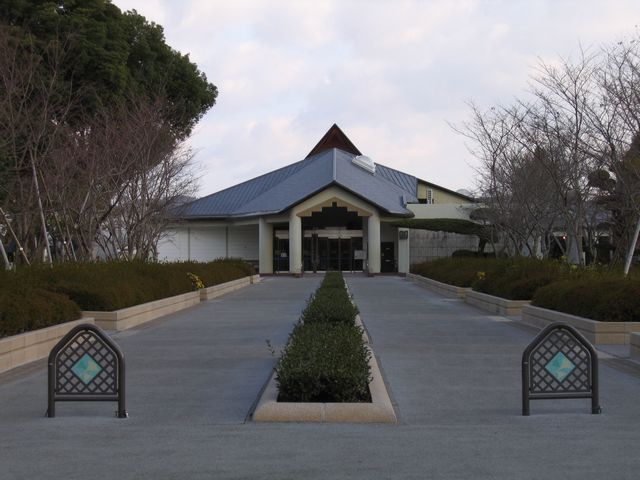
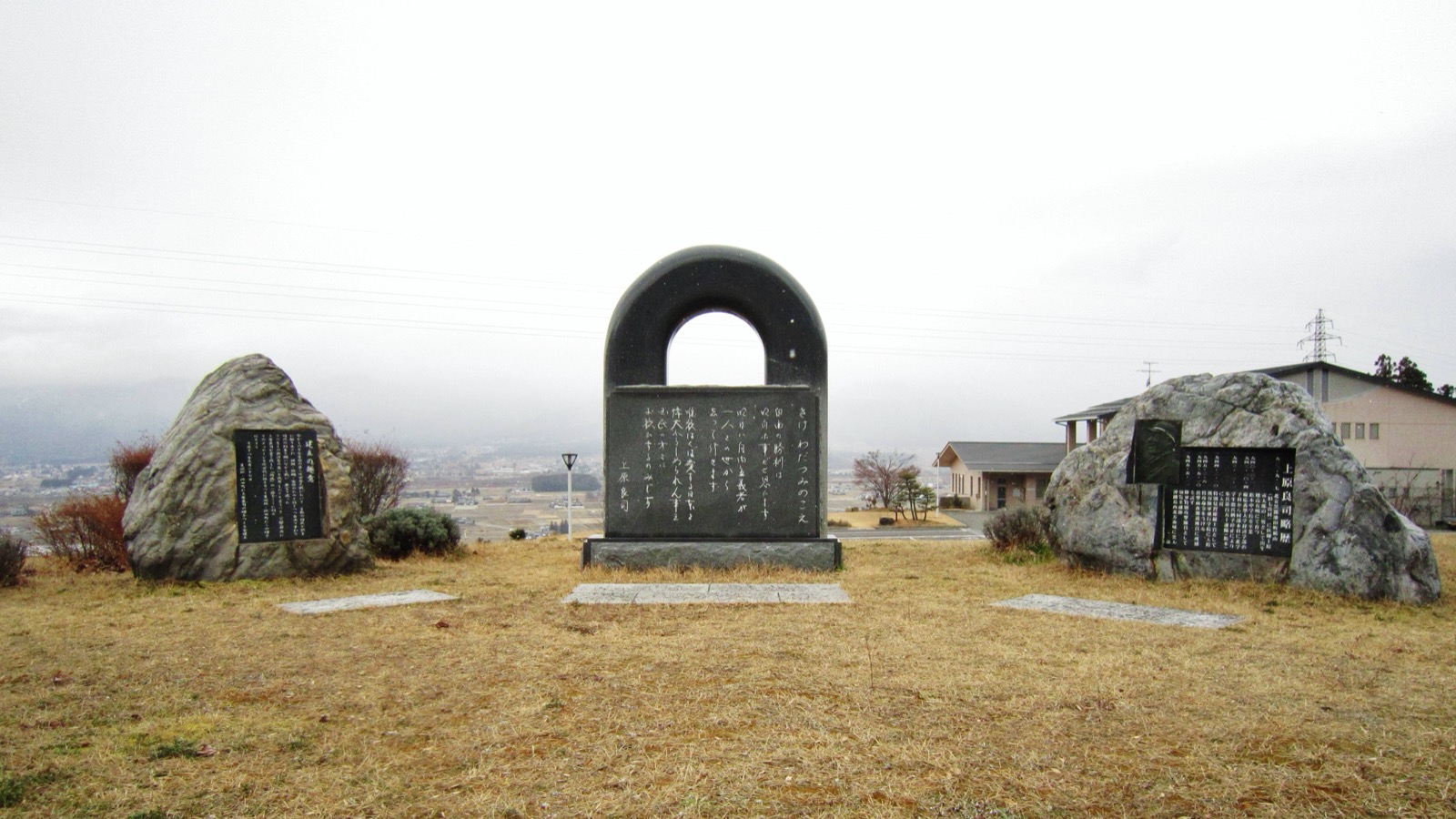
All are openly licensed photographs (CC BY-SA) from Wikimedia Commons. No photograph of Uehara Ryoji himself is shown here, because we could not verify a basis for an open licence.
⑨ In more detail — differing accounts, and what could not be verified
There is not much in history one can call absolutely certain. And Uehara Ryoji, precisely because he has been read more than almost anyone, is also the man later generations have “edited” the most. So where things are uncertain, we say so, and include them anyway.
🟢 Confirmedbacked by primary/secondary sources 🟡 Disputedsources or scholars differ ⚪️ Unverifiedplausible, but without evidence
1. How the “Reflections” were written, and to whom they were entrusted 🟡 Disputed
There is a discrepancy over how this last writing came to be. The correspondent Takagi Toshirō said, “I held out the paper, Uehara wrote on it, and I delivered it to the family.” Our films, too, follow Takagi's account.
But when the sources are compared, it is pointed out that the actual “Reflections” were not a jotting in a press notebook but were written on seven sheets of Nippon Eigasha press manuscript paper — which does not match Takagi's explanation. It is also suggested that the very situation of “Takagi being entrusted by Uehara” may have been embellished by Takagi, and the facts are not settled. Even behind a fine text, a narrator's own interests can enter. We leave it here, honestly, still unsettled.
Source: biographical record of Uehara Ryoji and accounts of the “Reflections” (seven manuscript sheets; the possibility of Takagi's embellishment) — primary sources, 2026. Scholars/era: a discrepancy between Takagi Toshirō's writings (1950s–70s) and later scrutiny.
2. The image of the “noble liberal” was partly polished by editing 🟡 Disputed
This may be the most important caveat in this episode.
When Uehara's writings appeared after the war in Kike Wadatsumi no Koe (“Listen to the Voices from the Sea”) and elsewhere, it is pointed out that they were subjected to arbitrary editing — including the deletion of phrases — to make the content “worthy of that precise, flawless thought.” In other words, the “perfect liberal, Uehara Ryoji” we know is, in part, an image made by later generations.
The most telling case is love. In Uehara's diary, besides Ishikawa Kyoko, the names of several other women appear. Hesitating over a confession, drawn to others too — a young man's wavering heart is written there. Yet when the writings were brought before the public, it is said that only the tragic love for Kyoko was emphasized, and the passages about other women were deliberately cut. The later world's wish to keep him a man of pure, tragic love erased his living, wavering self.
In episode 2, we too depicted his feelings for Kyoko. That is indeed one of his truths. But it is worth knowing, as well, that it has been polished as though it were the only truth. He was not a saint but a wavering twenty-two-year-old. Not erasing that ordinariness is, perhaps, the courtesy owed to this man.
Source: the arbitrary editing (phrase deletion) of Uehara's writings and the deletion of passages about other women — primary sources, 2026. ⚠️ We, too, in episode 2, were among those who emphasized Kyoko; this caveat is also a caution to ourselves.
3. Who was Croce — the source of “freedom wins in the end” 🟢 Confirmed
Uehara's repeated conviction that “freedom must win in the end” was not his own invention. Beneath it lies the history-philosophy of the Italian historian-philosopher Benedetto Croce (a man who openly opposed Mussolini's fascism). What Uehara read was Hani Gorō's study Croce. The line in the “Reflections,” “as that Italian, Croce, also says,” points to this favorite book. That the anti-fascist philosophy of enemy Italy became the backbone of a Japanese kamikaze pilot's last writing — this one point alone shows the complexity within this man.
Source: reception of Croce; Hani Gorō's Croce — primary sources, 2026.
4. The contradiction of “idealizing the British Empire” 🟡 Disputed
While rejecting authoritarianism and statism, Uehara idealized the British Empire. To champion liberalism while yearning for a great empire seems, at first, a contradiction. It is explained that, for him, “a Britain that built a great empire while keeping freedom and parliamentary government” was his ideal image of his own country. After the war, however, the British Empire was dismantled and only liberalism remained in the island nation of Britain. So it is also pointed out that “to tie the ideal of freedom to the ideal of the British Empire was, in the end, a mistake.” It is an important point, so as not to read his thought in a single admiring key.
Source: Uehara's view of the British Empire and the assessments of it — primary sources, 2026. Scholars/era: postwar intellectual-history evaluation.
5. Still in motion — a 2018 request from Britain 🟢 Confirmed
These “Reflections” are not paper of the past. It is reported that in 2018 the Imperial War Museum in Britain asked the bereaved family for permission to hold Uehara's “Reflections.” A young Japanese who, nourished by the philosophy of an Italian who opposed fascism, wrote “freedom wins” — and a former Allied nation now offers to keep his paper. Eighty years on, the fragment is still moving, still crossing borders.
Source: the Imperial War Museum's acquisition request (NHK report, 2018) — primary sources, 2026.
Sources (whole page)
- Ajima Takayoshi, Uehara Ryoji and the Kamikaze (rev. ed., 2010) / accounts by Nakajima Hiroaki (base texts for the episode scripts, verified)
- Uehara Ryoji, Ah, My Homeland, My Beloved — Kike Wadatsumi no Koe: Uehara Ryoji (Shinano Mainichi Shimbun, 2005)
- Takagi Toshirō, The Kamikaze Base Chiran and others (as objects of scrutiny regarding how the “Reflections” came to be)
- Biographical record of Uehara Ryoji (reception of Croce; Hani Gorō's Croce; the Self-Reflection Notebook; the editing history of the “Reflections”; his view of the British Empire; the 2018 British request; escort pilot Yoshihara Toshinori) — confirmed against primary texts, 2026
- Photographs: Wikimedia Commons (Alpsdake / Kakidai / Fuji-s / Qurren, CC BY-SA; photographer and licence are credited in each caption)
This channel does all selection of sources, verification of facts, and interpretation and final judgment of language by human hands. Parts of production (voice synthesis, image stylization, translation assistance) use AI. See our production principles.
⑩ Watch (all four episodes)
This story is told across four films.
- #001 Three brothers in Azumino, Shinshu →
- #002 The black circle — a code a student-soldier left behind →
- #003 Reflections — the victory of freedom is beyond doubt →
- #004 “Tomorrow, one liberal departs this world” →
We go looking for the next piece of paper. Subscribing, and a thumbs-up, are what make that possible.
Watch & subscribe on YouTube → The notebook not yet home (Maruta) → Follow on the map →
The facts in this article rest on primary sources and the (verified) episode scripts. The quoted “Reflections” and diary are the documents of Uehara Ryoji himself (rights term expired). On how the “Reflections” came to be and the editing history of the writings, differing accounts are set out in ⑨. The photographs are CC BY-SA images from Wikimedia Commons; the photographer, the licence name and a link to the licence text are shown in each caption, and the images have not been cropped or otherwise altered (only reduced in size). No photograph of Uehara Ryoji himself is shown here, because we could not verify a basis for an open licence.
Article text © 2026 Fragments of Japan ・ Corrections of factual error: contact@fragmentsjapan.com